


China’s New Perspective | How Will the Real Estate Sector Develop Over the Next Five Years? The Guiding Principles Are Here!
According to a report by China News Service on October 18 (reported by Zhongxin Finance journalist Zuo Yukun), the report of the 20th National Congress of the Communist Party of China outlined the direction for real estate development under the overarching framework of "enhancing people's well-being and improving their quality of life." Specifically, it stated: "We must uphold the principle that housing is for living in, not for speculation, and accelerate the establishment of a housing system characterized by multiple actors providing supply, multiple channels ensuring access, and a combination of rental and home purchase options."
What kind of impact will this have on China’s housing system and the development of the real estate market?
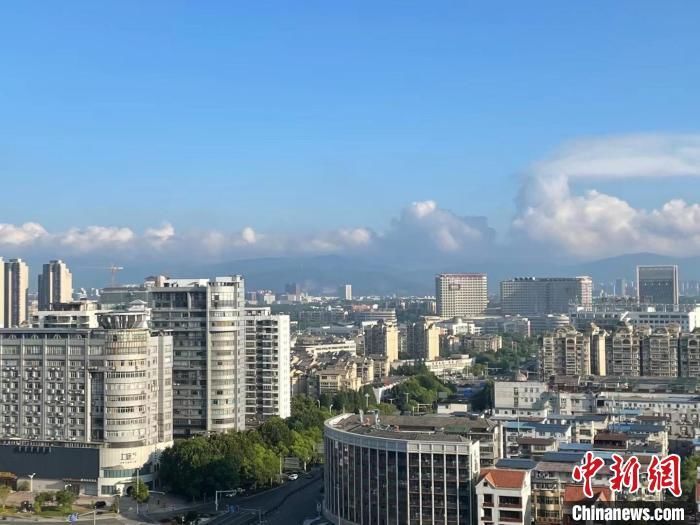
File photo: A view of the city. Photo by Yuan Rujing.
Reiterate “housing is for living, not for speculation.”
Since the end of 2016, after the Central Economic Work Conference first proposed adhering to the principle that “houses are for living in, not for speculation,” the concept of “housing is for living, not for speculation” was also incorporated into the report of the 19th National Congress of the Communist Party of China in October 2017.
“Over the past few years, despite the real estate sector experiencing ups and downs, the central government has supported localities in tailoring policies to suit their specific circumstances and optimizing housing market regulation measures. The principle of ‘housing is for living, not for speculation’ has remained the unshakable bottom line of policy,” said Chen Wenjing, Director of Market Research at the Index Division of the China Index Academy. She noted that after years of development, the concept of “housing is for living, not for speculation” has deeply taken root in people’s minds and become a societal consensus. As a result, homebuyers have become more rational when making property decisions, and the residential function of housing continues to be reinforced.
Chen Wenjing said that the report of the 20th National Congress once again emphasized that “houses are for living in, not for speculation,” demonstrating the steadfastness of policy. This also means that “housing is for living, not for speculation” will become a long-term guiding principle for China’s real estate sector. Going forward, the focus of real estate development will increasingly shift toward safeguarding people’s livelihoods and improving housing quality.
“In the future, reasonable housing demand will continue to be the primary focus of policy support and encouragement. There is still room for the release of both rigid and upgrade-oriented housing demand—especially as people’s aspirations for a better life become increasingly broad. As a result, upgrade-oriented housing demand could become a key pillar supporting the market,” said Chen Wenjing.
Reiterate “combining rental and purchase”
In addition to “housing is for living, not for speculation,” the concept of “promoting both rental and purchase” is also a well-known one.
The statement in the 20th Party Congress report—“Accelerate the establishment of a housing system featuring multiple actors providing supply, multiple channels for assurance, and a combination of rental and purchase options”—is consistent with the statement in the 19th Party Congress report.
“The focus of our work isn’t where we’re headed, but rather how we get there,” said Yan Yuejin, Research Director at the Think Tank Center of E-House Research Institute. This clearly indicates that over the next five years, the reform of the housing system will remain consistent with the guiding principles set forth at the 19th National Congress—that is, the overall direction will stay unchanged.
Li Yujia, chief researcher at the Housing Policy Research Center of the Guangdong Provincial Urban Planning Institute, also believes that this situation underscores two key points: On the one hand, the housing system that combines both renting and buying must be advanced with a strategic mindset that recognizes the urgency of the moment; on the other hand, building such a system will take time and require a gradual process before “renting” and “buying” can truly coexist and complement each other.
But there are also differences behind the same wording.
Yan Yuejin pointed out that in the report of the 19th National Congress, the housing system reform was discussed within the overarching framework of “improving and enhancing the standard of living and well-being of the people”; whereas in the report of the 20th National Congress, it was discussed under the broader framework of “enhancing people’s well-being and improving their quality of life.” It is evident that, on top of safeguarding people’s livelihoods, improving quality of life has also become an important component. In other words, the housing system reform must simultaneously pursue both the goals of safeguarding people’s livelihoods and enhancing their quality of life.
Li Yujia further analyzed and pointed out that the overarching guiding principle for housing work in the new era is remarkably clear: “housing is for living, not for speculation,” and “promoting both rental and home purchase options.” The former provides a comprehensive framework for housing policy, serving as the top-level guidance for nationwide industry and market regulation, innovation in management models and long-term mechanisms, and the advancement of a new housing system and institutional framework. The latter represents China’s strategic blueprint for further deepening housing system reform, exploring new models for real estate development, and promoting high-quality housing development.

Photo: Xi'an’s first publicly available affordable rental housing project officially goes into operation. Photo by Li Yihan.
“Renting and buying combined” is expected to accelerate.
At the end of 2015, the Central Economic Work Conference mentioned for the first time the development of the housing rental market and emphasized that “promoting both renting and buying” should be established as the primary direction for China’s housing system reform. Since then, the development of the housing rental market has significantly accelerated.
“Currently, China has initially established a favorable trend of multi-stakeholder development in the rental housing sector. State-owned leasing enterprises have played a leading, standardizing, activating, and regulatory role in the market, while an increasing number of professional and institutionalized housing rental enterprises are actively participating in market development,” said Zhao Ran, Director of the ICCRA Housing Rental Industry Research Institute.
“Since the second half of last year, the country has taken substantial steps to promote the procurement and construction of affordable rental housing, lower the threshold for new residents to register as household members, allow rentals to be registered under collective household registration, develop rental communities, and integrate renting with home buying,” Li Yujia noted. He believes that with the concerted efforts of all relevant parties, the development of a housing system that combines both renting and buying will significantly accelerate over the next five years.
“To develop the housing rental market—especially long-term rentals—the key lies in diversifying channels, providing sizable and professionally managed housing units, expanding the effective supply of rental housing, and enhancing the sustainability of development,” Zhao Ran pointed out. He added that localities should, based on factors such as housing supply and demand, incorporate newly built rental housing into their housing development plans and rationally determine the scale of rental housing construction.
“More importantly, as China’s real estate market gradually shifts from an incremental market to a stock-based market, we can actively revitalize existing assets through the renovation of existing housing stock, paving the way for a sustainable development of rental housing supply,” said Zhao Ran. (End)
