


Flying to the Sky, Realizing the Dream | As Mengtian Takes Off, the Aerospace Engineers Behind the Rocket’s “Nervous System”
On October 31, the Mengtian experimental module soared into the sky aboard the Long March-5B Y4 carrier rocket. As the “nerve center” of the Wenchang Space Launch Site, the rocket control system team played an indispensable role.
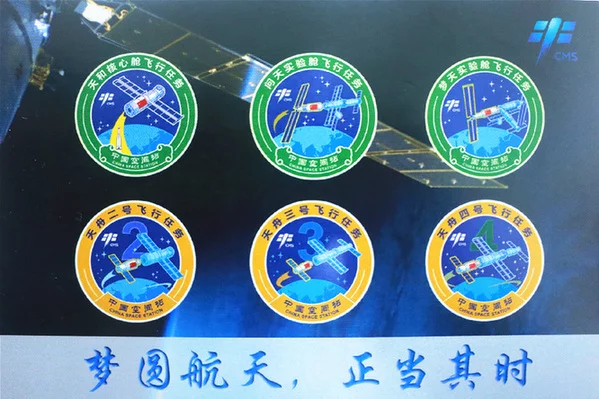
Wenchang Launch Site Space Station Construction Mission Promotional Card
“Zero-window” ignition allows for absolutely no margin of error.
The rocket control system is hailed as the “nervous center” of the rocket. Its primary function is to guide the rocket along its predetermined trajectory and ensure it enters orbit accurately. The control system team is responsible for testing and launching the rocket’s instruments and equipment. Whether these instruments and equipment operate normally in terms of performance and parameter status directly affects the success or failure of the rocket’s flight.
Yu Peng, the task leader of the control system, told reporters: “Achieving precise docking between the Mengtian module and the core module while they’re both moving at high speed requires that the ignition timing error be kept within one second. This places extremely high demands on our control system’s pre-ignition operations—every test and operation must be swift and accurate, leaving no room for even the slightest mistake.”
To ensure “zero-window” ignition, Yin Jingbo, the commander of the launch mission control system for the Mengtian module, led his team in repeatedly refining the pre-launch procedures, meticulously scheduling every step down to the minute—and even down to the second by 10 minutes before liftoff—thus guaranteeing that every stage and every operation leading up to launch would be precise and flawless.
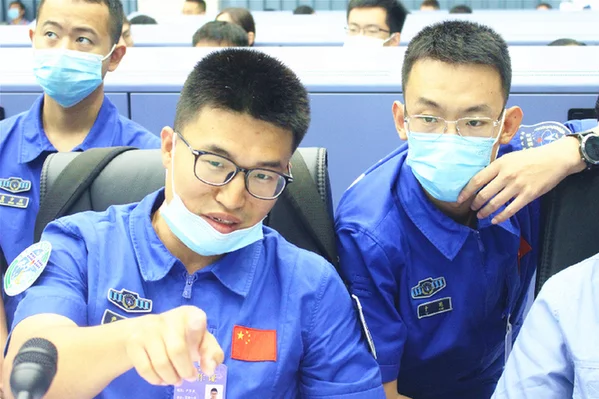
Yin Jingbo and Yu Peng discuss issues in the testing hall.
The integration of theory and practice must be close and tight. Conducting multiple rounds of pre-launch procedure drills enables personnel at each post to become thoroughly familiar with the timing for issuing every command and the specifics of each operational step, ensuring that they can swiftly interpret more than 400 status indicators and over 2,000 parameters and provide rapid feedback.
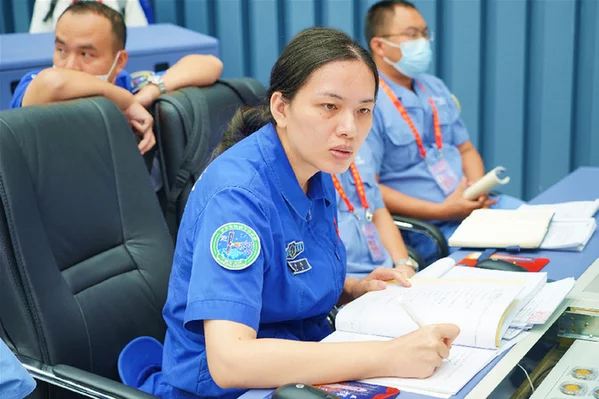
“Golden Finger” Liu Jinjie observes and records test parameters.
What should we do in case of an unexpected situation? To prepare for potential malfunctions, they’ve simulated over 190 possible failure modes and developed more than 410 corresponding response measures—all aimed at ensuring the rocket can be ignited on time.
Ten years of carrying burdens forward, all for a single, breathtaking flight.
One minute on stage requires ten years of hard work offstage. These ten years of painstaking effort are what this team has built up, bit by bit.
At the very beginning of the Wenchang Launch Site’s construction, with the control system’s software infrastructure in a state of “total blankness,” the team simultaneously studied theoretical knowledge of control systems, learned the theory behind the new signal rocket technology, and meticulously debugged and installed equipment. Relying on a spirit of hard work—“paving roads through mountains and building bridges over rivers”—they laid the foundation for the control system by creating operational procedures totaling nearly one million characters and accompanying instructional materials.
During those 908 days of pressing forward under heavy burdens, the control systems team quickly regrouped and set off again. They conducted round after round of specialized training sessions, meticulously refined their documentation time and again, and repeatedly rehearsed and practiced—designing their own circuit simulation models and connector operation boxes. They honed their theoretical knowledge, perfected their operational skills, and sharpened their collaborative abilities. With unwavering preparation and deeply accumulated expertise, they were determined to win the battle for redemption and honor. Even though the Long March-5 Y3 mission kept getting postponed, it could hardly dampen their passion and enthusiasm.
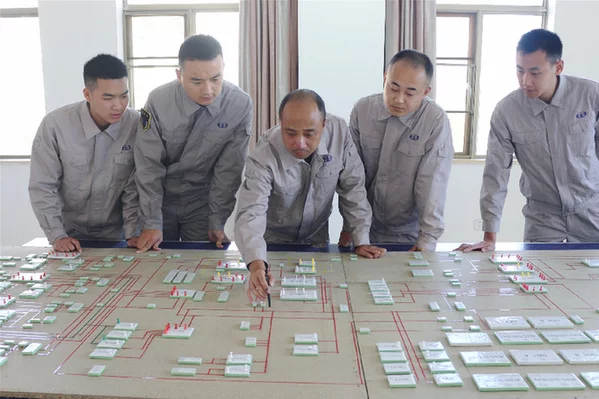
Control system personnel use circuit sandboxes for on-site teaching.
During the 2020 Spring Festival, the COVID-19 pandemic raged and spread rapidly. Nearly half of the personnel assigned to various posts were unable to return to their positions as scheduled. At the same time, two first-flight launch missions were being carried out concurrently. The pandemic brought with it unforeseen panic and other adverse factors that posed significant challenges to the control system.
Commander Yin Jingbo, who was in charge of the control system, recalled: “At the time, I served as the ‘golden finger’ for the maiden flight of the Long March-5B rocket and also doubled as the on-board operator for the Long March-7A. As soon as I finished one task, I quickly switched over to the other to carry out testing. The technical configurations of the two missions were different, so our team would spend every night conducting ‘double simulations’ and preparing for tests well into the late hours—everything we did was aimed at ensuring that our daytime preparations would be even more thorough. It was practically a nonstop, round-the-clock effort, working day and night.”

Slogan at the site where the Long March-7A rocket and spacecraft combination was transferred in March 2020
Liao Guorui, the commander of Mission 01 for the Mengtian module’s launch, told reporters: “At the time, I was in charge of the control system mission. I was deeply moved by the dedication and hard work of the personnel on duty—and by the professional spirit of many who stayed at their posts for nearly ninety consecutive days, putting the greater good above their own families.”
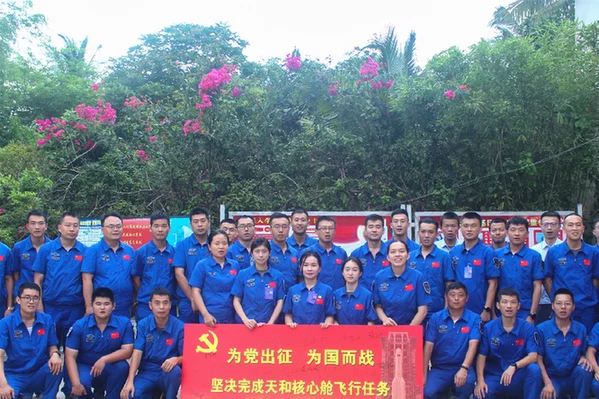
The Tianhe Core Module Mission Control System Holds a Mobilization Rally.
Facing the epidemic and marching toward the sky—this was the firm belief and unified action of the control systems team at the time. Through this shared journey of overcoming difficulties together, the control systems team significantly enhanced and matured its integrated measurement and launch capabilities, laying a solid foundation for consecutive successes in subsequent missions.
The road is long and fraught with obstacles, but with unwavering determination, we shall reach our destination.
It is in hardship that courage and determination become evident; it is through tempering that jade is perfected.
In 2021, after the Tianzhou-2 mission’s launch was twice aborted, propellant had to be drained and refilled twice. All the technical personnel of the test and launch team rallied under the battle cry: “We’ll spare no effort for the mission—unwavering in our commitment to it!” Thus began a mission relay race—a high-stakes race against time and a relentless struggle to overcome challenges.
The control system personnel remained fully alert and composed, keeping their minds steady and their footing firm. They worked closely with all systems, pulling together as one, overcoming difficulties hand in hand, and ultimately wrote a new aerospace miracle through their success.
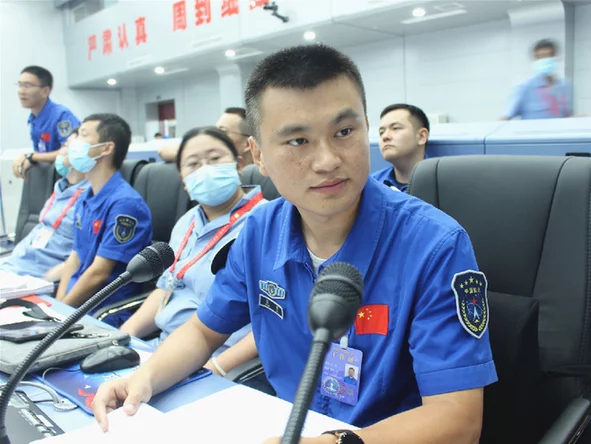
Zhang Bo, commander of the Tianzhou-2 control system
The high-density mission schedule in 2022 made time fly by. After the successful launch of the "Wentian" module, the team plunged right into a 90-day period during which three missions—the "Zhongxing," "Mengtian" modules, and "Tianzhou-5"—were being carried out concurrently and in parallel, leaving them with no time to rest. For this young team, such an “ultra-high-density” workload was entirely unprecedented. To make matters worse, Hainan was facing a severe epidemic situation at the time, adding further challenges due to staff fatigue, static management measures, and other adverse effects—yet another test for them.
The control systems team deeply understands that the space station construction mission is “of great significance and extraordinary mission.” They remain steadfast in their approach of “taking steady, solid steps,” cultivate an unshakable belief in victory, and firmly commit to daring to take on the challenge. Despite the pressure of consecutive high-density missions and the impact of static control measures, they have continuously fought under pressure, fully demonstrating their strong and reliable work ethic—“stepping up bravely before major battles.”
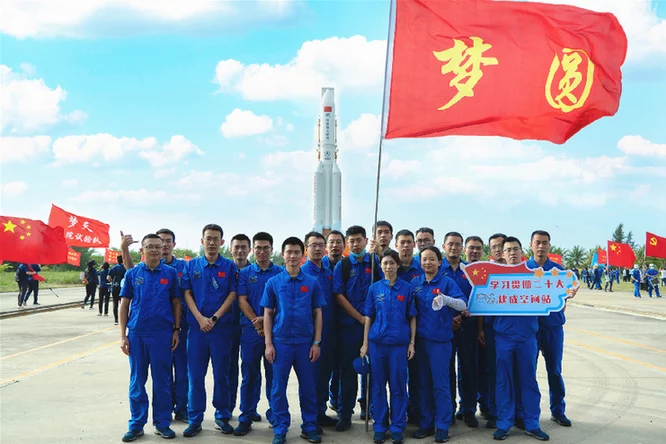
Control system technicians participate in the relocation activity of the Mengtian experimental module.
Control system personnel voluntarily gave up their scheduled days off to stay at their posts for nearly 30 consecutive days, working overtime to master the testing status and procedures with greater precision.
Sun Jing, the head of the servo mechanism for two different rocket models, is a breastfeeding mother who brought her infant close by for easy care—all to devote more energy to her mission.
Dou Tianheng, who holds three positions simultaneously; Hao Jianjun, who has postponed his wedding; Wang Puhua’s family, who is raising two children all by himself... and many other comrades—each one is demonstrating through their actions the spirit of dedication that puts the greater good above personal interests.
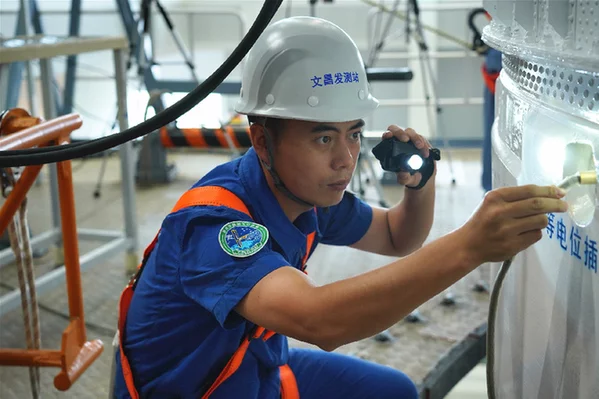
Control system personnel at the launch site check the test status.
Though ordinary and unknown, their cause is great.
Though their life is austere and they rise early and stay up late, they find it sweet and delightful.
Though it’s difficult, they move forward under great burdens as if carrying nothing at all.
All of this stems from the belief that “building a space power” and “using space technology to serve the country” has long been ingrained in our very being, forming the “winning gene” that drives us to strive relentlessly toward building a world-class space launch site and establishing China as a true space power.
(The manuscript was jointly planned by Xinhua Net and the Wenchang Space Launch Site.)
Editor-in-charge: You Yuanyuan_1000
