


From a regional perspective, from January to August this year, construction activity remained robust in several provinces across Northeast, Northwest, and Southwest China. With the introduction and implementation of a comprehensive package of policies aimed at stabilizing the economy, the overall machinery utilization rate in 17 provinces and cities saw month-on-month growth in July. Jilin Province even reached this year’s highest nationwide machinery utilization rate in August—78.01%.
In addition to infrastructure development, equipment such as reach stackers and forklifts—used in construction machinery—are closely linked to port container handling and import-export trade. This year, provinces and cities with robust foreign trade have been concentrated mainly in the southwest, central China, and northeast regions, with several inland provinces and cities showing particularly strong performance. In August, Sichuan Province recorded a port equipment startup rate of 88%, the highest level so far this year.
The “excavator index” remaining at a high level indicates that the proactive implementation of macro policies and the moderately ahead-of-schedule efforts to boost infrastructure investment have yielded significant results. Currently, from the central government down to local authorities, specific measures are being rapidly put into practice, enhancing the quality of traditional infrastructure while accelerating the development of new types of infrastructure.
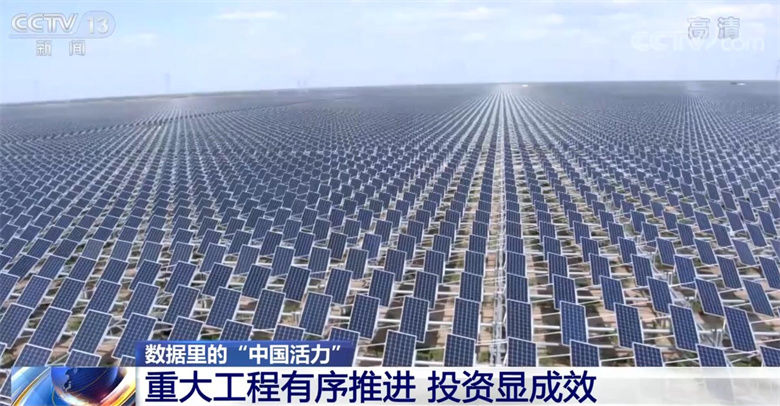
In Ningxia, the groundbreaking ceremony for the 3 GW new-energy photovoltaic integrated project—the largest desert-based PV power base in the country—was held a few days ago in the Tengger Desert. As a key supporting project for the “Ningxia Electricity to Hunan” initiative, this project has a total installed capacity of 3 million kilowatts and a total investment of 15.25 billion yuan.
In Hainan, Haikou City just held the third batch of major project groundbreaking ceremonies for 2022. This round of centralized project starts includes 30 projects with a total investment of 17.39 billion yuan, and planned investments for this year amount to 3.05 billion yuan.
Since the beginning of this year, the construction of the 102 major projects outlined in the 14th Five-Year Plan has been steadily accelerated, and the more than 2,600 projects already broken down have been implemented smoothly and in an orderly manner.
Su Zimeng, President of the China Construction Machinery Industry Association: I believe that throughout this year, the construction machinery industry will maintain a stable operating state, and exports should see rapid growth. The introduction of a series of major pieces of equipment to the market has effectively met the needs of key national (economic) construction projects.
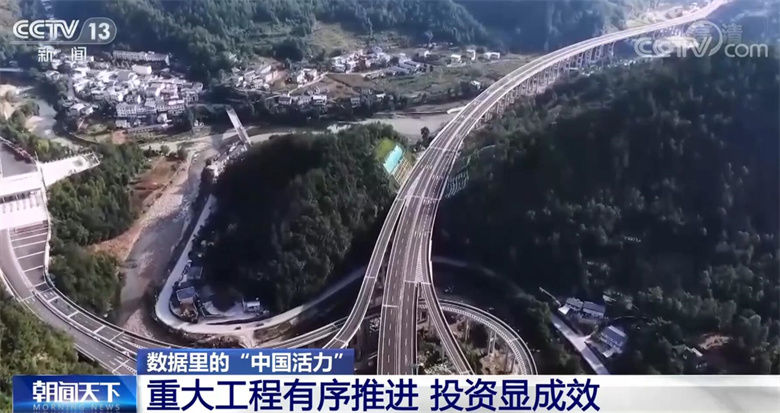
Recently, China’s policy-based and development-oriented financial instruments have continued to expand in scale. At a recent State Council executive meeting, it was clearly stated that, building on the 300 billion yuan already allocated to specific projects through these policy-based and development-oriented financial instruments, an additional amount of over 300 billion yuan will be added. The scope of support will now include the renovation of old residential communities and provincial-level expressways. Furthermore, local governments’ unused special bond quotas accumulated since 2019—exceeding 500 billion yuan—will be activated in accordance with the law. Of this amount, 70% will remain under local jurisdiction, while 30% will be centrally managed by the central government and allocated preferentially to regions with more mature projects. Priority support will be given to transportation infrastructure, energy, agriculture, forestry, water conservancy, ecological and environmental protection, social undertakings, cold-chain logistics infrastructure for urban and rural areas, municipal and industrial park infrastructure, major national strategic projects, affordable housing projects, new energy projects, and new infrastructure construction projects.
The construction of major projects is in full swing, driving investment and continuously boosting the development of China's construction machinery industry.
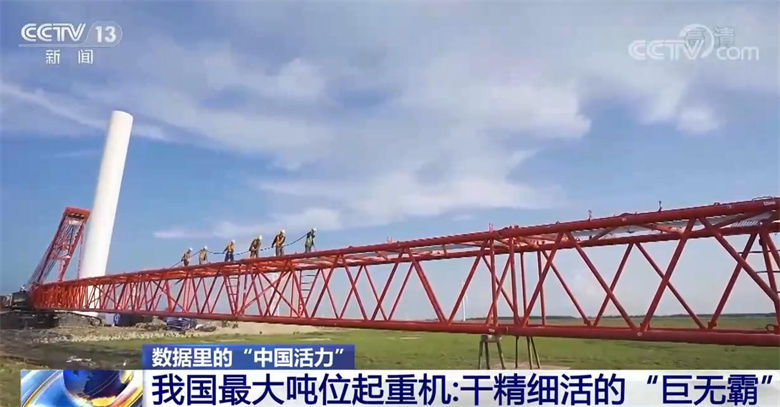
In recent years, China has achieved historic breakthroughs in many major pieces of equipment. From the 4,000-ton crawler crane and the 2,000-ton all-terrain crane to hydraulic excavators weighing over 100 tons, engineering machinery equipment has been steadily moving toward the mid-to-high end segment. Next, let’s take a look at a domestically produced “giant”—currently the largest-tonnage crane in China. Not only can it lift weights up to 4,500 tons, but it can also perform highly precise operations accurate to within a millimeter.
Not long ago, at the integrated refining and chemical construction site in Longkou, Shandong, a reactor—32.7 meters high and weighing over 1,400 tons—was lifted into its designated position. The lifting equipment used was China’s currently largest crawler crane, with a lifting capacity of 4,500 tons. Despite their enormous size, the precise positioning of these massive structures was accurate to within millimeters.
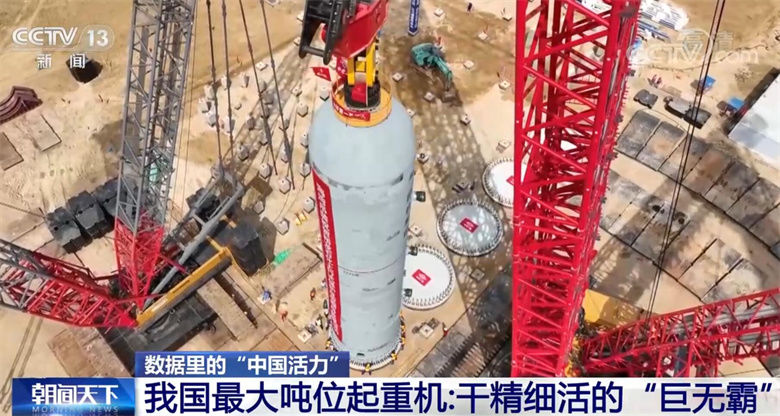
Zhang Yang, Deputy Director of a certain equipment research institute: “Our vehicle is equipped with all sorts of sensors. By simply moving a handle, it can make tiny adjustments, ensuring that there’s no impact when we finally align the hole.”
Large-tonnage cranes are expensive and have long production cycles, so for more than a decade prior to this, they relied entirely on imports. Over the course of more than ten years of research and development, the research team collaborated with numerous domestic universities and used digital prototypes to conduct repeated trial-and-error experiments.
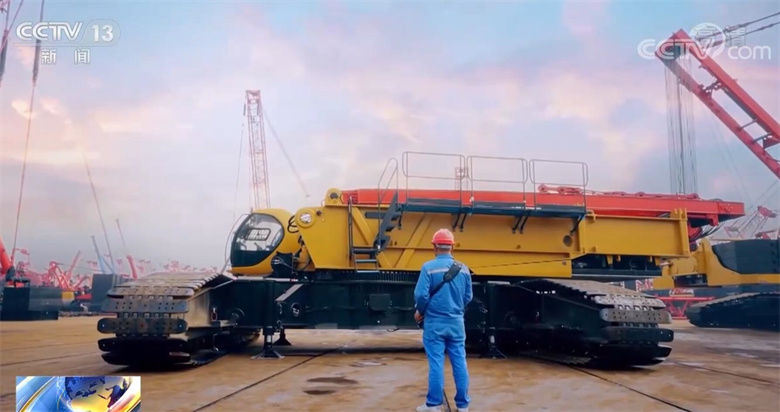
Zhang Yang, Deputy Director of a certain equipment research institute: “We’ve created a digital prototype—essentially a physical machine replica. We’ve also built an exact digital twin on the computer, including a fully integrated electromechanical-hydraulic power system, and then we’re conducting joint simulations.”
After more than a decade of continuous trial and error, domestically produced heavy-duty cranes have finally begun to shine in the construction of major projects. Not only do these cranes boast the world’s heaviest lifting capacity, but they can also undergo structural transformations. The “human-shaped” boom system is wide at the base and narrows toward the top, which not only enhances the crane’s stability but also allows it to split a 4,500-ton load into two independently operating 2,000-ton units. This modular design not only meets the construction team’s diverse lifting requirements for various weights but also helps reduce costs associated with crane loading, unloading, and transportation.
In addition, before construction begins, the company will tailor solutions specifically to the needs of each project operation, ensuring both engineering safety and the gradual localization of materials used in crane components, thereby reducing manufacturing costs and driving collaborative efforts across upstream and downstream enterprises.
Zhang Yang, Deputy Director of a certain equipment research institute: We’ve partnered with well-known domestic steel mills—both for steel plates and steel pipes—and can deliver within three months. It now takes us less than a year to build a single crane, and our costs have been cut in half. (Now) the steel mills have even started exporting back to overseas markets the very same steels we’ve been using.
